Fish oil won’t magically fix everything ; but the right Omega-3 can support heart health, reduce inflammation, and sharpen your brain. Here’s what science really says.
The omega 3 fats are one of the primary contributors to optimal function of the body by working specifically to maintain good brain health. [2]
There are three main types of omega 3 – eicosapentaenoic acid (EPA), docosahexaenoic acid (DHA), and alpha-linolenic acid (ALA) that all contribute to how well the body functions. [2]
If an individual does not consume fatty fish at least 2 or 3 times per week as part of their diet, obtaining enough omega 3 fatty acids can be difficult. [5]
Therefore, fish oil is one of the most commonly used forms of an omega-3 fat supplement and algal oil is another alternative supplement to consider using the various options that exist.
The Different Forms of Omega-3
The fact that there are many different chemical forms of Omega-3s is not known at all by the majority of people. Furthermore, your body cannot absorb every different type of omega 3 equally well across those different chemical types. [3]
The omega 3 fats contained in whole fish (as opposed to supplements) are primarily in the natural (true) forms of: free-fatty-acids, phospholipid and triglyceride; which is how your body utilizes these nutrients.
However, the omega 3 fats found in most fish oil supplements (non-refined) are primarily in the triglyceride form. After the fish oil has been refined, most impurities have been removed and the EPA and/or DHA levels have been increased to desired levels; however, for those fish oils that have been further refined and have had their impurities removed, they have converted much of the triglycerides to ethyl-ester form. [3]
While converting the fish oil to ethyl-ester makes it easier to have a higher concentration of the omega 3 fats; your body will not absorb them as well as when in triglyceride form. Some manufacturers convert ethyl esters to a higher quality form, or reformed triglycerides, which the body absorbs better than ethyl esters [4], but they cost more.
Benefits have been proven through eating fatty fish may not be able to be obtained through supplements. [1]
Breaking Down the Supplement Types
- Natural Fish Oil — Derived directly from oily fish tissue, this is the most straightforward option. A typical 1,000 mg serving contains roughly 180 mg of EPA and 120 mg of DHA, along with vitamins A and D. Common sources include salmon, sardines, herring, mackerel, tuna, and cod liver. It’s available in both capsule and liquid form. [2]
- Processed Fish Oil — This is the most widely available type on the market because it’s affordable and convenient. The oil is purified to remove contaminants (ex. mercury and PCBs) and concentrated to increase the levels of EPA and DHA; however, processed fish oil generally contains ethyl esters created during purification that absorb poorly. Also, processed fish oils are prone to oxidation/rancidity, quality manufacturers take steps to reduce the likelihood of oxidation or rancidity through packaging. [3]
- Krill Oil — Extracted from tiny Antarctic shrimp-like creatures, krill oil delivers omega-3s in both triglyceride and phospholipid forms. Studies suggest absorption is comparable to — and sometimes better than — standard fish oil [3]. Krill oil has a natural advantage: it contains astaxanthin, a powerful antioxidant that makes it highly resistant to going rancid. Because krill are so small and short-lived, they accumulate very few contaminants, so the oil rarely needs extensive purification.
- Green-Lipped Mussel Oil — Native to New Zealand, this oil provides EPA and DHA along with a rare omega-3 called eicosatetraenoic acid (ETA), which may have additional anti-inflammatory properties. It’s also considered an environmentally responsible choice.
- ALA Oils (Plant-Based) — Foods like flaxseed, chia seeds, and hemp seeds are rich in ALA, the plant form of omega-3. The catch is that your body has to convert ALA into EPA or DHA before it can use it, and that conversion process is quite inefficient [2]. Most plant oils also contain significantly more omega-6s than omega-3s, which limits their usefulness as a primary omega-3 source.
- Algal Oil — This one comes from microalgae — the same place fish get their omega-3s in the first place. Fish eat algae, and the fatty acids work their way up the food chain. Algal oil is an excellent option for vegetarians and vegans since it delivers EPA and DHA directly without any animal products. It’s also free from heavy metals and other contaminants, making it both a clean and sustainable choice. Some algal oils also provide beneficial minerals like iodine.
Which Type Should You Choose
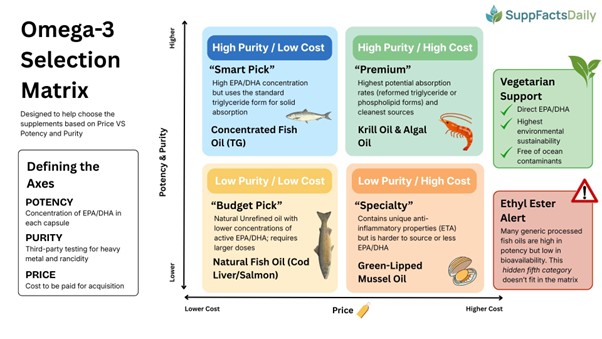
For most people, a standard fish oil supplement does the job well. That said, keep in mind that natural fish oil is typically only about 30% EPA and DHA — the rest is other fats.
If you want a more concentrated dose, look for supplements where EPA and DHA make up a higher proportion, sometimes as much as 90% of the total content. [2]
Absorption Hierarchy:
- Free Fatty Acids (FFA) – Best absorption
- Triglycerides (TG) & Phospholipids (PL)
- Ethyl Esters (EE) – Least absorption
How to Consume
Whatever type you choose, take it with a meal that includes some fat — it significantly improves absorption. But why?
Dietary fat triggers the release of pancreatic enzymes that are required to break down the triglyceride or ethyl ester bonds in your fish oil.
Taking your supplement with a high-fat meal (like eggs, avocado, or full-fat yogurt) can increase the absorption of ethyl ester forms by up to 300%.[3]
Pro-Tip: Spotting Rancid Oil
Rancid Omega-3 is not just ineffective, it can be pro-inflammatory.
- Enteric Coatings can mask the foul smell of oxidized or spoiled oil. Break one capsule open occasionally to check. The “rotten” odour means it should be discarded.
- Vitamin E (Tocopherols) on the label acts as a natural preservative, preventing this oxidation. [3]
What to Check Before You Buy
Since the FDA doesn’t regulate supplements the way it does medications, the quality and accuracy of labeling can vary significantly. Research has shown that a meaningful portion of omega-3 supplements don’t actually contain what their labels claim. Here’s what to look for:
- EPA & DHA Labels: Confirm the supplement contains EPA and DHA specifically, not just a generic “omega-3” blend.
- Concentration: A capsule labeled “1,000 mg fish oil” might only contain 300–320 mg of EPA and DHA combined. Always check the breakdown on the back label.
- The chemical form: Look for FFA, TG, rTG, or PL — these absorb well. Avoid products where EE (ethyl esters) is the primary form.
- Third-party testing: Look for a certification seal from an independent testing organization, which confirms the product contains what it claims.
- Freshness: Check the expiration date and assess the smell. A product with vitamin E added acts as a natural preservative and is a good sign.
- Sustainability: Certifications from organizations like the Marine Stewardship Council (MSC) or the Environmental Defense Fund indicate responsible sourcing.
As a general guideline, daily intake of EPA and DHA combined shouldn’t exceed 3,000 mg [3], with no more than 2,000 mg coming from supplements.
The Bottom Line
A quality fish oil supplement is a solid choice for anyone who doesn’t regularly eat fatty fish. That said, whole food sources like salmon or sardines appear to offer benefits beyond what supplements alone can provide. If you follow a plant-based diet, algal oil is the one supplement that delivers true EPA and DHA without any animal-derived ingredients.
Buy smaller quantities to keep the oil fresh, and store it properly. Omega-3s are perishable, and freshness matters more than most people realize.
References
[1] Harvard Health Publishing: Fish oil: friend or foe?
[2] National Institutes of Health: https://ods.od.nih.gov/factsheets/Omega3FattyAcids-Consumer/
[3] National Center for Biotechnology Information: https://www.ncbi.nlm.nih.gov/pmc/articles/PMC4678768/
[4] European Food Safety Authority https://www.efsa.europa.eu/en/efsajournal/pub/2815
[5] Harvard Health Publishing: https://www.health.harvard.edu/diet-and-nutrition/omega-3-foods-incorporating-healthy-fats-into-your-diet
Pingback: Supplements for Women Over 40: Feel Younger, Stronger & Healthier - SuppFactsDaily
Pingback: The Causes of Mood Swings in Women and Natural Treatments - SuppFactsDaily
Pingback: 5 Acne Diet Myths We Can Finally Debunk - SuppFactsDaily
Pingback: 4 Types of Dietary Fat: The Essential Guide to Healthy Fats - SuppFactsDaily
Pingback: Skin Health Supplements: Benefits for a Radiant, Glowing Complexion
Pingback: Omega-3 Rich Foods: Best Sources for Heart & Brain Health - SuppFactsDaily
Pingback: Eggs and Cholesterol: How Eggs Can Support Healthy Levels - SuppFactsDaily